Crypto Poker in Nigeria: Player Rooms vs Casino Poker, Pot Odds, Rake, Bankroll and Staying Safe
Welcome bonus for new players + fast crypto payouts. Just helping a brother out.
18+. Crypto deposits. Cloudbet is licensed in Curaçao, not in Nigeria. Ad: we may earn a commission. Bet only what you can afford to lose.
My brother, poker is the one casino game where the person across the table, not the house, is usually your real opponent. That's why so many Nigerians who are tired of slots end up searching for crypto poker in Nigeria. Done right, it's a game of skill and patience. Done wrong, it's a fast way to hand your USDT to sharper players, bots, or a WhatsApp "club" that disappears overnight. This guide covers both sides: the maths that wins pots and the checks that keep your money safe.
18+ only. Since the Supreme Court judgment of 22 November 2024 (SC/1/2008), states regulate gambling in Nigeria (the LSLGA in Lagos, for example) and the NLRC covers the FCT. Cloudbet, the crypto casino we link to, is licensed in Curaçao and is not licensed by any Nigerian state regulator. All naira amounts and probabilities below are examples or script-computed figures, not results from any real poker room.
Two very different things are called "crypto poker"
Before anything else, know which game you're actually looking at, because the maths is completely different.
| Player vs player (peer-to-peer) poker | House-banked casino poker | |
|---|---|---|
| Who you play against | Other players at the table | The casino (a dealer or software) |
| How the site earns | Rake: a small cut of each pot or a tournament fee | A built-in house edge on every hand |
| Can skill make you a long-term winner? | Yes, if you're better than the table after rake | No. Good strategy only reduces the edge |
| Examples | Texas Hold'em and Omaha cash games, sit-and-gos, tournaments | Casino Hold'em, Three Card Poker, Ultimate Texas Hold'em, Caribbean Stud, video poker |
| Main risks | Stronger players, collusion, bots, unsafe clubs | The house edge, speed of play, chasing losses |
Many crypto casinos, Cloudbet among them, focus on casino and live-dealer tables rather than running a big peer-to-peer poker room. Check the casino lobby for poker-style tables before you deposit; we don't promise any particular poker game there, because lineups change. If you want true player-versus-player poker, you need a dedicated poker room, and the safety checks later in this guide matter a lot.
House-banked poker: know the edge you're paying
Casino poker games are fun, quick and simple, but they're still casino games. Here are commonly quoted house edges with optimal strategy (exact figures depend on each table's paytable and rules):
| Game | Typical house edge (on the ante) | Expected cost per ₦1M in antes |
|---|---|---|
| Video poker, Jacks or Better 9/6, perfect play | about 0.46% | about ₦4,600 |
| Casino Hold'em | about 2.16% | about ₦21,600 |
| Ultimate Texas Hold'em | about 2.19% | about ₦21,900 |
| Three Card Poker (ante/play) | about 3.37% | about ₦33,700 |
| Caribbean Stud | about 5.22% | about ₦52,200 |
Two things to notice. First, the side bets (pair plus, bonus jackpots, progressive add-ons) usually carry much bigger edges than the main game, so they're where the house makes its real money. Second, video poker with a full-pay table and correct strategy is one of the cheapest games in any casino, but only if you learn the strategy chart. Play it by feel and the edge climbs fast. A "9/6" table pays 9 for a full house and 6 for a flush on a one-coin bet; lower paytables like 8/5 or 7/5 cost you noticeably more.
If house-banked tables are what you'll play, treat them like our crypto blackjack guide suggests: learn the basic strategy, skip most side bets, and set a session budget before the first hand.
Player-vs-player poker: you're playing the table, not the house
In a real poker room, the site doesn't care who wins the pot. It takes a slice (rake) and leaves the rest to the players. That's why skilled players can win over time: their edge comes from opponents' mistakes. But it also means you're only a winner if you're clearly better than the people you sit with, after paying rake. Sit at the wrong table and you're the one making the mistakes.
The rest of this guide is mainly about this kind of poker, starting with the two numbers every winning player knows by heart: outs and pot odds.
Counting outs: your chance to hit
An "out" is any unseen card that turns your hand into the likely winner. With a flush draw you usually have 9 outs; an open-ended straight draw has 8. Here are the exact chances compared with the popular shortcut (multiply outs by 4 on the flop for two cards to come, by 2 on the turn for one card):
| Outs | Flop to river (exact) | Rule of 4 | Turn to river (exact) | Rule of 2 |
|---|---|---|---|---|
| 2 (pocket pair hoping for a set) | 8.4% | 8% | 4.3% | 4% |
| 4 (gutshot straight) | 16.5% | 16% | 8.7% | 8% |
| 6 (two overcards) | 24.1% | 24% | 13.0% | 12% |
| 8 (open-ended straight) | 31.5% | 32% | 17.4% | 16% |
| 9 (flush draw) | 35.0% | 36% | 19.6% | 18% |
| 12 (flush + gutshot) | 45.0% | 48% | 26.1% | 24% |
| 15 (flush + open-ended) | 54.1% | 60% | 32.6% | 30% |
The shortcut is close enough for small draws but overstates big combo draws on the flop. Also remember that the "flop to river" figure assumes you'll see both cards. If someone can bet big on the turn and make you fold, your real chance is closer to the one-card figure.
And be careful with "dirty" outs. If you're drawing to a flush and the board pairs, your flush may lose to a full house. Some of your outs are less valuable than they look, so a careful player discounts them.
Pot odds: is the call worth it?
Pot odds compare what you must pay with what you can win. If an opponent bets, the equity (chance of winning) you need to call profitably depends on the bet size relative to the pot:
| Opponent bets | Equity you need to call |
|---|---|
| ¼ pot | 16.7% |
| ⅓ pot | 19.9% |
| ½ pot | 25.0% |
| ¾ pot | 30.0% |
| Full pot | 33.3% |
| 1.5× pot | 37.5% |
Here's a naira example. The pot is ₦20,000 on the turn. Your opponent bets ₦10,000 (half pot). You hold a flush draw with 9 clean outs, so your chance on the river is 19.6%. You need 25% to break even. Calling costs you on average:
- Win 19.6% of the time: you gain ₦30,000 (the pot plus the bet).
- Lose 80.4% of the time: you lose your ₦10,000 call.
- Average result of calling: about −₦2,174 per call.
So the raw call loses money. That doesn't automatically mean fold, which brings us to implied odds.
Implied odds: money you expect to win later
Implied odds count the extra chips you'll win on the river when you hit. In the example above, how much extra would you need to win on average, when your flush comes in, to make the call break even? Our script says about ₦11,111. If your opponent will happily pay a decent river bet when the flush lands, calling becomes fine. If the flush is obvious and they'll shut down, it isn't.
Implied odds are best when your draw is hidden (for example a gutshot that nobody expects) and your opponent has a big stack and a strong but not unbeatable hand. They're worst when stacks are short, because there's no extra money to win later. A quick rule: the shorter the effective stack, the more you should rely on pure pot odds.
Rake: the quiet killer of win rates
Poker players measure results in big blinds won per 100 hands (bb/100). Rake is measured the same way. Imagine a solid player who beats the table by 8 bb/100 before rake:
| Rake paid (bb/100) | Net win rate | What it means |
|---|---|---|
| 3 | +5 bb/100 | Healthy winner |
| 5 | +3 bb/100 | Winning, but slowly |
| 8 | 0 | All your skill goes to the site |
| 10 | −2 bb/100 | Good player, losing money |
Rake usually hits small stakes hardest, because the cap on each pot is large compared to the blinds. Before you join any room, read its rake page: the percentage, the cap per pot, whether it takes rake on pots that end before the flop ("no flop, no drop" is the friendly version), and tournament fees. Rakeback deals can soften the blow; just make sure they're paid in a coin you can actually withdraw.
Bankroll: how many buy-ins you really need
Even winning players lose for weeks. Bankroll is measured in buy-ins. One buy-in at a no-limit cash game is usually 100 big blinds, so if the big blind is ₦100, a buy-in is ₦10,000. Using a standard risk-of-ruin formula with a typical swing of 90 bb per 100 hands:
| Your true win rate | 20 buy-ins | 30 buy-ins | 50 buy-ins |
|---|---|---|---|
| +2 bb/100 (small winner) | 37.2% chance of going broke | 22.7% | 8.5% |
| +5 bb/100 (solid winner) | 8.5% | 2.5% | 0.2% |
So at ₦100 big blind, a small winner wants something like 50 buy-ins (₦500,000) to sleep well, and a solid winner can manage with 30 (₦300,000). If you're not sure you're a winner at all, and most new players aren't, then poker money is entertainment money and should be treated exactly like a casino budget.
Moving down in stakes after a downswing isn't shameful; it's how good players survive. Our staking plan guide is written for sports bettors, but the same principle applies: size your games to your bankroll, not to your ego.
Swings are bigger than you think
We simulated a solid player winning 5 bb/100 with that 90 bb swing, 20,000 times each:
| Hands played | Average result | Chance of being behind | Bad-luck result (worst 5%) |
|---|---|---|---|
| 10,000 | about +510 bb | 28.8% | about −974 bb |
| 50,000 | about +2,489 bb | 10.8% | about −827 bb |
Read that again: a genuinely good player can be down almost 1,000 big blinds after 10,000 hands, which is ₦100,000 at ₦100 blinds, through pure bad luck. More than one in four solid winners is behind after 10,000 hands. That's why you can't judge your skill from a few weekends, and why chasing losses by moving up in stakes is so dangerous.
Tournaments: big prizes, bigger swings
Tournaments are popular because a small buy-in can turn into a big score. Here's an example payout structure for a 200-player event with ₦5,000 buy-ins plus a ₦500 fee, making a ₦1,000,000 prize pool, paying the top 30:
| Finish | Share of pool | Prize |
|---|---|---|
| 1st | 25% | ₦250,000 |
| 2nd | 15% | ₦150,000 |
| 3rd | 10% | ₦100,000 |
| 4th–6th | 5% each | ₦50,000 each |
| 7th–10th | 3% each | ₦30,000 each |
| 11th–20th | 1.5% each | ₦15,000 each |
| 21st–30th | 0.8% each | ₦8,000 each |
Half the prize pool goes to the top three. Now the swing: even a strong player who makes the final three twice as often as average (3% of the time) has about a 21.8% chance of zero top-three finishes in 50 tournaments, and about 4.8% in 100. A player who cashes 18% of the time still has a 13.7% chance of no cash at all in ten events. Tournament bankrolls therefore need many more buy-ins than cash games, often 100 or more for regular players.
Also watch the fee. A ₦500 fee on a ₦5,000 buy-in is 10%, which is a big hurdle. Lower-fee events help your long-term results more than most strategy tips.
Hand numbers every beginner should know
A lot of bad poker comes from wrong ideas about how often things happen. These are exact figures from simple card counting in Texas Hold'em:
| Situation | Exact chance | Roughly |
|---|---|---|
| Being dealt any pocket pair | 5.9% | 1 hand in 17 |
| Being dealt pocket aces | 0.45% | 1 hand in 221 |
| Being dealt ace-king (any suits) | 1.2% | 1 hand in 83 |
| Being dealt two cards of the same suit | 23.5% | about 1 hand in 4 |
| Pocket pair flops a set or better | 11.8% | about 1 flop in 8.5 |
| Suited hand flops a made flush | 0.84% | about 1 flop in 119 |
| Suited hand flops a flush draw | 10.9% | about 1 flop in 9 |
| Unpaired hand pairs at least one card on the flop | 32.4% | about 1 flop in 3 |
| Unpaired hand pairs at least one card by the river | 48.7% | about half the time |
| Someone at a 9-handed table holds aces when you hold kings | about 3.9% | rare, but it happens |
Two lessons sit inside that table. First, "suited" cards make a flush far less often than players imagine, so don't overvalue weak suited hands. Second, a small pocket pair mostly hits a set about one time in eight, so calling big raises just to "set mine" only works when the stacks behind are deep enough to pay you off when you hit.
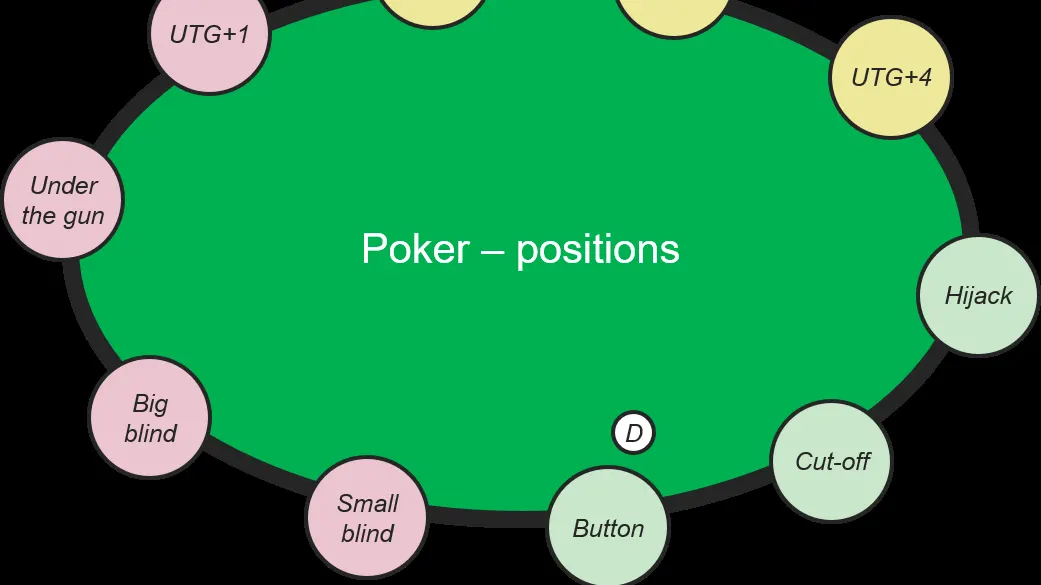
Starting hands by position, kept simple
Position means where you sit relative to the dealer button. The later you act, the more you see before deciding, so the more hands you can play. A simple starting plan for a full table at low stakes, when nobody has raised yet:
| Your seat | Hands to open-raise | Idea |
|---|---|---|
| Early (first few seats after the blinds) | Big pairs, medium pairs, ace-king, ace-queen, strong suited aces | Many players still to act, so stay tight |
| Middle | Add smaller pairs, ace-jack, king-queen, suited broadway cards | Slightly wider |
| Late (cut-off and button) | Add suited connectors, more suited aces and kings, some offsuit broadway hands | You act last after the flop, so you can play more |
| Small blind | Similar to middle position | You'll be out of position after the flop |
This isn't a perfect chart, and strong players adjust it all the time. But simply cutting out weak hands from early seats will save most beginners more money than any fancy bluff.
18+. Crypto deposits. Cloudbet is licensed in Curaçao, not in Nigeria. Ad: we may earn a commission. Bet only what you can afford to lose.
Bet sizing without overthinking
New players often bet tiny amounts with strong hands and huge amounts with bluffs, which tells sharp opponents everything. Keep it steady:
- Pre-flop opens: a raise of around 2.5 to 3 big blinds is standard. Add about one big blind for each player who already limped in.
- Continuation bets on dry boards: about a third of the pot often does the job.
- Wet boards with many draws: bet bigger, around two-thirds to three-quarters of the pot, so draws pay a fair price. Check the pot odds table above to see why.
- River value bets: size to what a worse hand will call, not to what you wish they would call.
Cash games, sit-and-gos or tournaments?
| Format | Good for | Watch out for |
|---|---|---|
| Cash games | Steady practice, leaving whenever you like, simple bankroll rules | Rake at small stakes, playing too long |
| Sit-and-gos (single table) | Short sessions, fixed cost per game | Fees can be high as a share of the buy-in |
| Multi-table tournaments | Big prizes from small buy-ins | Very long dry spells, long sessions into the night |
If your goal is to learn, cash games at the lowest stakes with low rake give the clearest feedback. If your goal is a weekend thrill, a small tournament buy-in is a fixed, known cost, which makes budgeting easier.
Simple strategy habits that save money
- Play fewer hands. Most new players lose by playing too many weak starting hands, especially from early positions. Position matters: acting last gives you more information.
- Raise or fold more, call less. Calling without a plan is the most expensive habit in poker.
- Don't bluff players who never fold. At low stakes, value-bet strong hands and save bluffs for opponents who can actually lay down a hand.
- Respect big river raises. At most small-stakes tables, a huge late raise is much more often a strong hand than a bluff.
- Take notes. If a player always folds to a raise, or always calls, write it down. Poker sites usually allow player notes.
- Stop when tilted. After a painful loss, decisions get worse. Leave the table for a while.
Common leaks and how to plug them
| Leak | Why it costs money | The fix |
|---|---|---|
| Calling raises with weak offsuit aces | You're often dominated by a better ace and lose big pots | Fold most of them from early seats |
| Chasing every draw | Raw pot odds are often too short, as the ₦2,174 example showed | Check outs against the bet size before calling |
| Slow-playing big hands | Opponents check behind and you win a tiny pot | Bet your strong hands; most players call too much anyway |
| Playing tired or after drinks | Decisions drop off fast late at night | Set a finish time before you sit down |
| Moving up after a big win | One good night isn't proof of skill | Move up only when your bankroll rules say so |
| Ignoring rake | A small winner can become a loser | Compare rooms and favour lower caps |
A sensible first month
If you're new to crypto poker, here's a calm way to start without burning money. In week one, deposit a small amount you're fine losing, play the lowest stakes, and focus only on starting hands and position. In week two, start counting outs on every draw and compare them with the pot odds table before each call. In week three, keep a simple log of hands played, results and rake paid, so you can see your real numbers. In week four, review that log. If you're losing steadily, stay at the lowest stakes or switch to free play while you study. If you're winning, keep the same stakes until your bankroll meets the buy-in guide above. Patience here is worth more than any strategy video.
Club apps, WhatsApp groups and Telegram poker: be very careful
A lot of Nigerian poker happens in private clubs on mobile poker apps, with chips bought from an "agent" over WhatsApp or Telegram and settled in crypto or bank transfer. Some are run honestly by friends. Many are not. The common problems:
- The agent holds your money. There's no licensed operator behind your balance, just a person. If they vanish, so does your money.
- Collusion. Two or three players sharing hole cards on a call or chat can crush everyone else at the table.
- Bots and solver help. Software that plays or advises in real time is a real problem, especially in loosely run clubs.
- Delayed or "pending" cash-outs that never arrive, or fees that appear only when you try to withdraw.
- Pressure to recruit friends to unlock withdrawals, which is a clear scam sign.
Our guide to betting groups in Nigeria covers the same warning signs from the sports side. The short version: if you can't identify who runs the game and where your money sits, don't play for amounts you'd be upset to lose.
Picking a crypto poker room as a Nigerian player
- Find out who runs it. A real company name, a stated licence (and an honest note that offshore licences aren't Nigerian ones), and published terms.
- Read the rake and fee pages before you sit down. Compare rake caps and tournament fees between rooms.
- Check game security. Look for a clear policy on collusion, bots and real-time assistance, and evidence that accounts actually get closed for it.
- Test deposits and withdrawals small. Send a small amount in, play a little, withdraw it. Only then think about adding more.
- Check traffic at your hours. Nigeria is on WAT. Rooms with mostly European or Asian players may have quiet tables at times you want to play.
- Look for limit tools. Deposit limits, session reminders and self-exclusion should be easy to find.
Identity checks are normal at bigger withdrawals, even on crypto sites. See does Cloudbet have KYC for how one crypto operator handles it, so you know the kind of thing to expect.
Moving crypto in and out safely
- Use the right network. USDT on TRC20 and USDT on ERC20 are not interchangeable. Sending on the wrong network can lose funds permanently. Our page on how to deposit crypto at a casino explains networks, memos and minimums step by step.
- Stablecoins keep your bankroll steady. If you play in BTC and the price drops 10% in a week, your bankroll shrinks even when you're winning at the tables. Our guide to crypto betting coins compares the options.
- Withdraw winnings regularly to a wallet you control. Don't leave a big balance on any poker site.
- Keep a simple log of every deposit, withdrawal and session result.
Is it provably fair?
Peer-to-peer poker rooms deal cards from a shuffle you usually can't verify yourself, and a few crypto rooms offer verifiable shuffles. Casino "house originals" are more often provably fair. If that matters to you, read our explainer on the provably fair casino idea, and remember it proves the deal wasn't changed, not that the game is profitable for you.
Tax and records
Treat poker results like any other gambling income: keep records, and understand the rules where you live. Our page on betting tax in Nigeria explains the current picture in plain words. If you ever move larger sums through a bank, clean records of where the money came from will save you a lot of stress.
Legal position in Nigeria
Since the Supreme Court ruling of 22 November 2024 (SC/1/2008), gambling is regulated by each state (for example the LSLGA in Lagos), with the NLRC covering the FCT. Offshore crypto poker rooms and casinos are licensed abroad, if at all. Cloudbet is licensed in Curaçao and is not licensed by any Nigerian state regulator, so Nigerian regulators can't help in a dispute. Private poker clubs often have no licence anywhere. Read is casino legal in Nigeria and is online betting legal in Nigeria for the details.
Know when to stop
Poker feels like a skill game, which makes it easy to tell yourself the next session will fix the last one. If you're chasing losses, playing longer than planned, borrowing to reload, or hiding your play from family, take a break and talk to someone. Gamble Alert offers free 24/7 help on +234 916 295 7989, or toll-free on +234 705 889 0073 and +234 705 889 0074. Our responsible gambling page has limit-setting tips.
Final word
Crypto poker in Nigeria can mean two things: house-banked casino poker, where good strategy only shrinks the edge, or player-versus-player poker, where skill can win but rake, swings and dishonest clubs can wipe you out. Learn outs and pot odds, read the rake page, keep a proper bankroll, test withdrawals small, and stay away from agents holding your money. 18+ only. Cloudbet is licensed in Curaçao and is not licensed by any Nigerian state regulator.
Questions punters ask
Can you play crypto poker from Nigeria?
Many offshore crypto poker rooms and casinos accept players from Nigeria, but they're licensed abroad, not by a Nigerian state regulator. Check who runs the site, its rake and its withdrawal rules before you deposit.
Is casino poker the same as playing against other players?
No. House-banked games like Casino Hold'em or Three Card Poker have a built-in house edge, roughly 2% to 5% on the ante. In player-versus-player poker, the site takes rake and you win or lose against the other players.
How do I work out pot odds?
Divide the amount you must call by the final pot if you call. A half-pot bet means you need 25% equity; a full-pot bet means 33.3%.
How many buy-ins do I need for poker?
For no-limit cash games, 30 to 50 buy-ins is a common guide for winning players. Tournament players usually need 100 or more because swings are much bigger.
Are WhatsApp and Telegram poker clubs safe?
Many are risky. An agent usually holds your balance, there's no licensed operator behind it, and collusion or unpaid cash-outs are common complaints. Only play amounts you can afford to lose.
Does Cloudbet have a poker room?
We don't promise any specific poker game there. Cloudbet runs a crypto casino with table and live-dealer games; check its lobby for poker-style tables, as lineups change.
Is Cloudbet licensed in Nigeria?
No. Cloudbet is licensed in Curaçao and is not licensed by any Nigerian state regulator.
Where can I get gambling help in Nigeria?
Gamble Alert: +234 916 295 7989; toll-free +234 705 889 0073 or +234 705 889 0074.
18+. Crypto deposits. Cloudbet is licensed in Curaçao, not in Nigeria. Ad: we may earn a commission. Bet only what you can afford to lose.
If betting has stopped being fun, talk to someone. Gamble Alert, a Nigerian non-profit, runs a free, confidential 24/7 helpline: +234 916 295 7989, toll-free +234 705 889 0073 / 0074. Source: gamblealert.org.